AESOP@TU DORTMUND
As part of the "One University - One Book" program, which was initiated by the Stifterverband and the Klaus Tschira Foundation in cooperation with DIE ZEIT, TU Dortmund University has been listening to, reading, playing, sharing, interpreting, researching, discussing and questioning Aesop's fables in a variety of formats since the 2017/18 winter semester.
Aesop's ancient fables deal with exemplary situations of human coexistence and thus also values such as respect, loyalty and friendship, but also problems such as overreaching, manipulation and scarcity of resources. They are not only world-famous, but also short, accessible to everyone - and they invite discussion.
The humanities and natural sciences, art, philosophy and economics, the Secretariat Management Network and the AStA jointly designed a rich program on Aesop, the results of which were summarized and presented in their diversity in a publication on the project at the end.
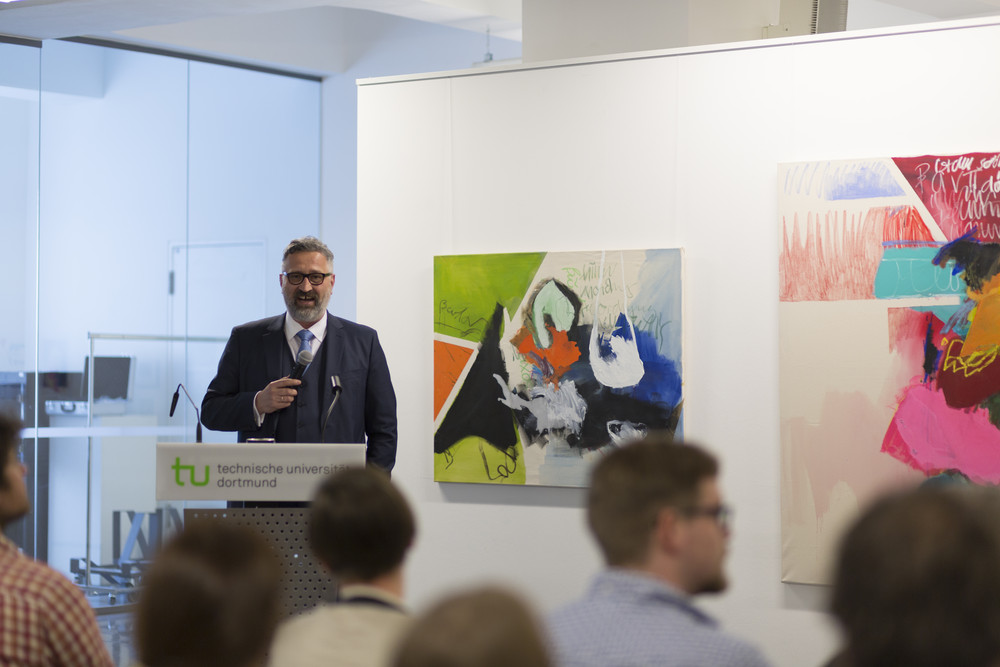
The artistic work area Painting at the Department of Art and Art Studies took part in the Aesop@TU Dortmund project with several seminars. The results of the artistic work in the seminars were shown in a total of three exhibitions, in two exhibitions in the Bildwechsel series on TU Dortmund University's South Campus and in the final exhibition of the project at the Hochschuletage in the Dortmunder U. Like all exhibitions in this series, the two exhibitions on Bildwechsel used functional spaces on the South Campus - foyers, stairwells, corridors and offices. They were set up during the course of the project and thus documented the progress of the students' engagement with the theme, in a sense the progress of the project in the artistic field of painting. At the end, the exhibition at the Hochschuletage in TU Dortmund University once again brought together exemplary student positions on Aesop@TU Dortmund and demonstrated the breadth of artistic engagement with the topic.
For the students, their examination of Aesop's fables was ultimately not about illustrating them once again, but rather making them the starting point for a pictorial fabulation that reflects on the relationship between humans and animals against the backdrop of the multifaceted concept of nature.
One of the oldest surviving works of art is a mythical creature - the "Lion Man" carved from the tusk of a mammoth from the Stadel Cave in Hohlenstein in the Swabian Alb. The impressive sculpture, which is around thirty centimetres high, can be found in the Ulm Museum. To this day, art and popular culture vary the motif of the transition from human to animal as a motif of a magical-instrumental approach to nature on the one hand and as a form of symbolism on the other, which makes it possible to create an image of man in the image of the animal and to play with one's own nature in the image.